The transition nobody talks about
You've spent years knowing exactly what you want. Your hands, your timing, your rhythm. You know the pattern that works, the speed that gets you there, the angle that makes you feel most like yourself. And then you meet someone, and suddenly that intimate knowledge you've built feels like it belongs in a locked drawer.
Here's what I see in my practice: people who've had rich solo lives often feel ashamed of their pleasure when partnering again. Like their device, their specificity, their knowledge of their own body is somehow cheating on the new relationship. It's not. It's the opposite. You're bringing real data into the conversation.
Why your solo routine doesn't automatically transfer
There's a massive difference between pleasure alone and pleasure with someone watching. Not worse. Different. Your nervous system responds to presence differently. Vulnerability shifts things. The brain chemistry changes when another person is there, which means your body might respond faster or slower, with more intensity or less. That's not dysfunction. That's just neurobiology.
When you've been using a lemon clitoral vibrator solo for years, you've trained your body to respond to a specific stimulus in a specific way. The pattern, the intensity, the pressure. Your partner doesn't have to replicate that exactly. They have to understand it exists, and then you rebuild from there together.
The conversation before the bedroom
Here's where most couples get stuck: they wait until clothes are off to mention the vibrator. Bad timing. Do this sitting on the couch, fully dressed, with tea or coffee nearby.
Start with curiosity, not confession. Something like: "I've been using a toy that really works for me, and I'd like to incorporate it when we're together. What do you think?" Not "I need this to orgasm" or "I've been using this for years." Just factual, forward-looking.
If they seem hesitant, that's worth exploring right then. Ask what's underneath it. Often it's not about the vibrator. It's about feeling like their touch isn't enough, or worry they're doing something wrong, or just unfamiliarity with the device. Those are real conversations that need air before you get to the bedroom.
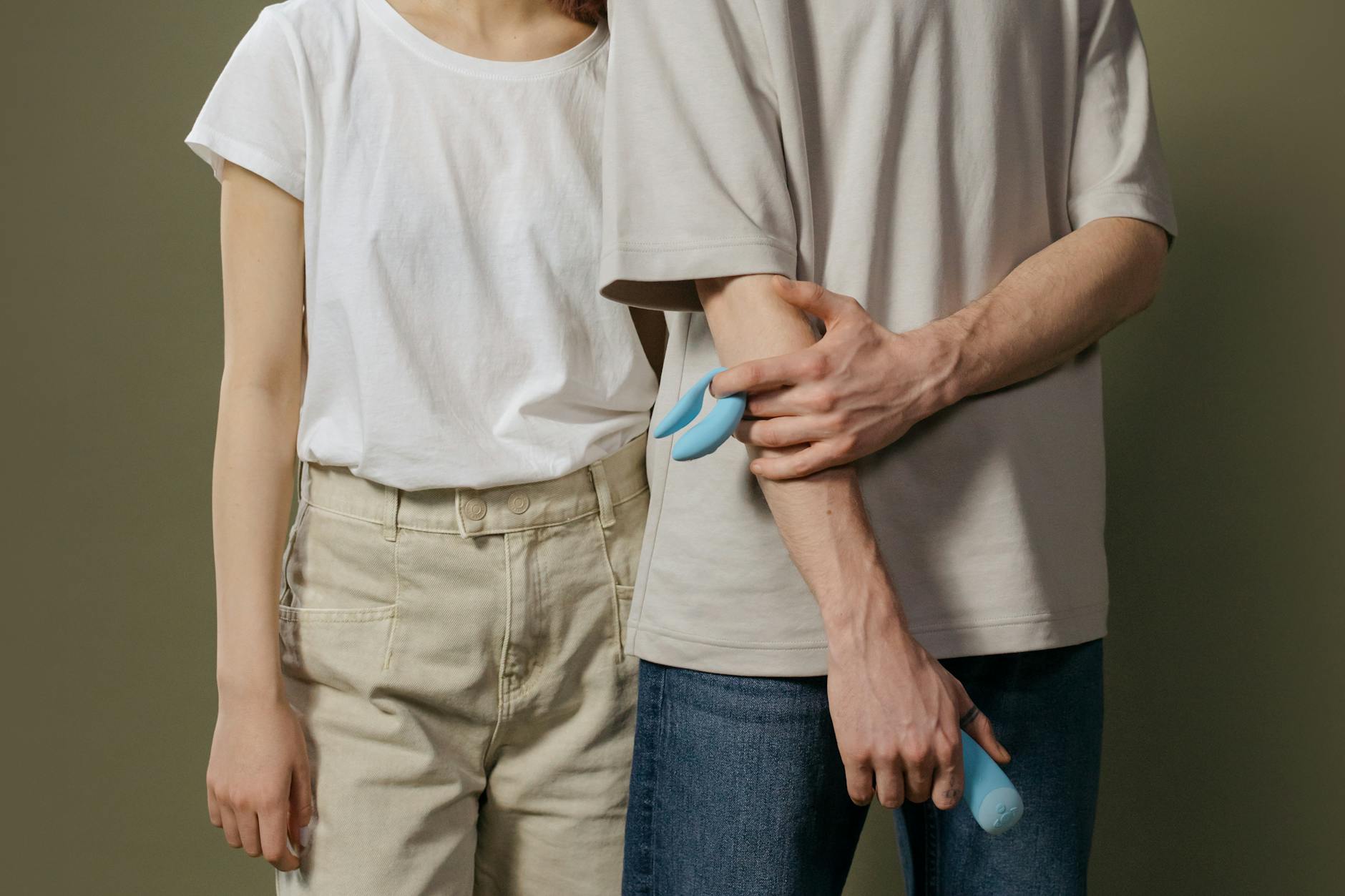
Photo by FounderTips on Pexels
The first time with someone else present
Lower the stakes. This isn't the time to aim for an orgasm. This is reconnaissance. You're teaching them how your body responds. You're letting them see what you do, and then you're exploring what happens when they're involved.
Start with the vibrator on a low setting while you're kissing them. Not during penetration yet, not as part of a big production. Just during foreplay, so they can see how your body shifts. Let them hold it sometimes. Let them feel the vibration against their hand first, before it touches your skin. Familiarity removes the weirdness.
Many people report that the first few times feel clinical. That's normal. You're literally debugging a three-body system. Let it be awkward. Awkward then becomes comfortable if you both stay curious instead of self-conscious.
Building shared pleasure, not parallel pleasure
One major shift from solo to partnered: you're no longer in total control of the pacing. This is actually a feature, not a bug. When you've been using lemon clitoral vibrators alone, you've optimized for your own trajectory. With a partner, there's a rhythm to negotiate. And negotiation creates intimacy.
Try this: you hold the vibrator at first, but they control the speed using your partner's hand over yours on the control. That way you're both managing the intensity, and you're literally connected to the decision-making. It removes the phantom feeling of "my body, their witness" and makes it collaborative.
Or they hold it, but you give real-time feedback. "Slower," "stay there," "higher." This turns the device into a communication tool, not a replacement for them.
Over time, you'll probably find that partnered pleasure requires different timing. You might need more warm-up. You might find that some patterns that worked solo feel too intense or not intense enough now. That's data. Adjust.
What happens when sensitivity shifts with someone else
If you've been solo for a long time, your body might have developed specific patterns of arousal. Sometimes people find that stimulation that felt perfect alone feels a bit numb or overstimulated once a partner is involved. This happens because your nervous system is processing more input. Pleasure isn't just a physical circuit. It's your entire body, your emotional state, your sense of safety with this person.
If that happens, don't immediately assume the device is the problem. You might just need to move it or adjust the setting. You might need longer foreplay. You might need to revisit the conversation about what this means to both of you, because sometimes pleasure flatness is actually an emotional signal that something in the dynamic needs attention.
This is also where many couples benefit from slowing down and checking in. "Is this working for you? Do you want me to try something else?" These questions create safety.
Integrating the device into partnered sex, not replacing it
The goal isn't to use the lemon clitoral vibrator instead of your partner. It's to use it with them. That means there are times they're using their hands or mouth, and you might hold the vibrator yourself. There are times they're inside you and you're using the device. There are times you're both focused on different kinds of stimulation simultaneously.
This requires a new kind of communication than solo play demanded. You might use a traffic light system: green is "keep going," yellow is "this is good but I need a tiny adjustment," red is "stop, something's uncomfortable." Some couples develop shorthand. Others just stay verbal and keep checking in.
What matters is that neither of you is pretending the device doesn't exist or that you don't need it. You do. And that's okay. Accepting that about yourself is actually one of the sexiest things you can do in a partnership, because it means you're not performing. You're being real.
The mind shift that makes everything easier
Here's what changes everything: stop thinking of the vibrator as a solo thing you're bringing into the relationship, and start thinking of it as a tool you both get to use. Your partner isn't competing with it. They're collaborating with it. The device doesn't replace their hand or their attention. It adds dimension.
When you frame it that way, the awkwardness usually evaporates. You're not hiding a habit. You're inviting them into something that works for your body. Most partners, once they see how much pleasure you're experiencing, get curious instead of threatened. They want more of that for you.
When to reach out for support
If this conversation keeps stalling, or if one of you feels persistently uncomfortable even after trying a few times, that's worth bringing to a couples therapist. Sometimes what looks like a vibrator problem is actually a deeper communication gap or a wound around pleasure or trust. A professional can help you untangle that without judgment.
Same thing if your pleasure response completely flatlines with a partner, or if anxiety spikes when they're present. These aren't failures. They're signals. And signals deserve attention.
The long view
Most couples who integrate a device into their partnered life find that it becomes just another part of the toolkit. Like lube or positions. You use it sometimes, you don't other times. It's there when you need it and not a big deal when you don't. The weird energy around it usually fades within a few weeks if you stay curious and kind with each other.
Your years of solo play weren't wasted. They taught you what your body needs. Now you get to teach someone else. That's not a loss. That's data. And data, shared with the right person, is deeply intimate.